
Why Growing Truly Organic Coffee Still Forces Africa’s Women Farmers to Sell Dirt Cheap
The world is paying more for sustainably produced coffee, shea butter, and textiles. Across Africa, many of the women who make them cannot afford the certification needed to claim the premium.
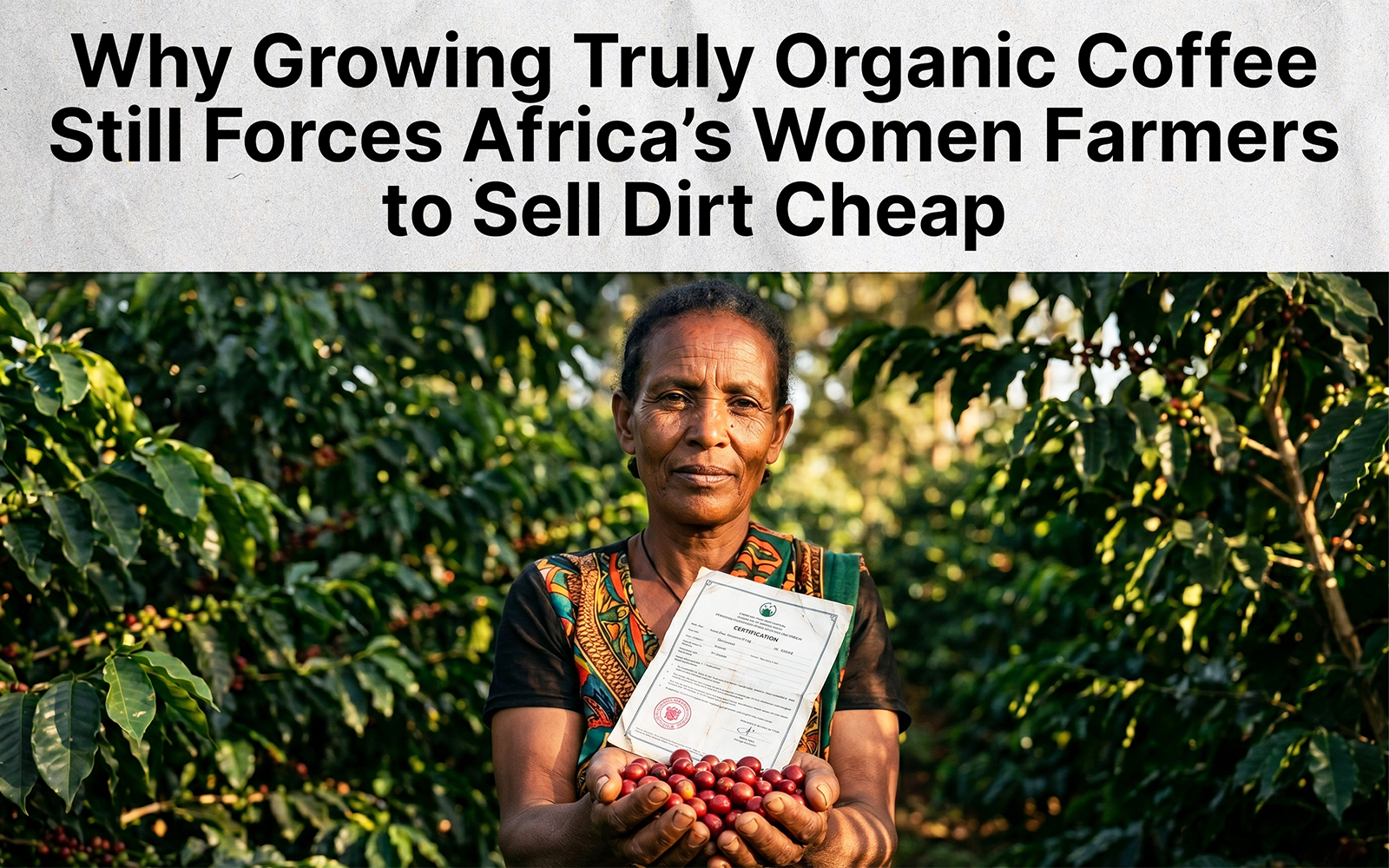
The global green economy is now worth more than $5 trillion a year and is growing twice as fast as conventional industries, projected to reach $7 trillion by 2030. Consumers in Europe, North America, and East Asia are willing to pay nearly 10 percent more for sustainably produced goods — a premium that is real, documented, and growing. Ethiopian smallholder coffee farmers who achieve Fairtrade or Rainforest Alliance certification have access to that premium directly. Those who do not sell into the same commodity pool as everyone else, at the same commodity price, regardless of how their coffee was grown. The gap between those two outcomes is not a gap in product quality. It is a gap in paperwork.
This is the structural problem that sits beneath the headline number. Women account for an estimated 70 percent of informal cross-border traders across Africa, a sector valued at approximately $17.6 billion annually. They move food, textiles, cosmetics, and agricultural goods across borders, sustaining households and stitching together supply chains in the spaces the formal economy does not reach. In Benin, women informal traders contribute 64 percent of the value added in trade. In Mali, 46 percent. In Chad, 41 percent. They are not peripheral to Africa’s trade economy. They are load-bearing. And they are almost entirely shut out of the certified, premium-access, internationally recognised green market that is now the fastest-growing segment of global consumer spending.
The barrier is specific. International buyers — European supermarkets, specialty coffee roasters, ethical fashion brands — require proof. Certifications such as Fairtrade, Organic, UTZ/Rainforest Alliance, GlobalG.A.P., and ISO standards are increasingly mandatory for access to premium markets in Europe and North America. Each certification carries an application cost, an audit cost, an annual renewal cost, and a compliance burden that requires documentation, traceability systems, and ongoing record-keeping. For a smallholder farmer in Jimma or Sidama growing genuinely organic, shade-grown, heirloom Arabica, the certification that would unlock a premium of 20 to 40 cents per pound above commodity price can cost more than her annual net income to obtain. Research on Ethiopian coffee confirms that certified farmers realise real benefits but face higher costs — and the costs fall disproportionately on the smallest producers, who are disproportionately women.
Ethiopia’s coffee sector makes the stakes concrete. Ethiopia earned $1.87 billion from coffee exports in the ten months to May 2025, with the country producing a projected 11.6 million 60-kilogram bags in the 2025/26 marketing year. Export prices peaked at 423 US cents per pound in April 2025 as global supply tightened. Ethiopian Arabica, grown in the birthplace of coffee across the highlands of Yirgacheffe, Harrar, and Sidama, commands genuine interest from the specialty segment — the buyers who pay most. Yet the share of VSS-certified Ethiopian coffee exports remains below the global average, meaning the country is selling into a premium market at a discount to its own potential because the women who grow the majority of it cannot afford the document that would prove what the cup already demonstrates. Coffee is Ethiopia’s largest export. The certification gap is a revenue gap measured in hundreds of millions of dollars.
The structural solution exists and has been named. The AfCFTA — Africa’s continental free trade agreement — is projected to unlock $450 billion in regional income and lift 30 million people out of extreme poverty by 2035, according to the World Bank. Its Women and Youth in Trade Protocol is specifically designed to address the informal-to-formal transition for traders who are already operating. A McKinsey study projects that bridging Africa’s gender gap in trade could add $316 billion to continental GDP. The conference organised by ImpactHER in Abuja in May 2026, attended by ministers from nine countries, proposed the mechanism: pooled certification, where cooperatives or producer networks share the cost of third-party audits across their membership, making the per-farmer cost of a Fairtrade or Organic certificate manageable at the scale of a village cooperative rather than crushing at the scale of an individual smallholder. Participatory Guarantee Systems — local, trust-based certification frameworks recognised by some international buyers — offer a lower-cost entry point while the full third-party infrastructure is built. These are not theoretical workarounds. They are operating models. They are simply not yet operating at scale.
The $5 trillion green economy is not waiting for Africa to catch up. It is already sourcing from Africa — Ethiopian coffee, Ghanaian shea butter, Kenyan eco-textiles — and in many cases paying the premium to intermediaries and export houses rather than to the women whose hands produced the product. The certification is the valve that controls who captures the premium at the farm gate. Until the cost of obtaining that certification falls within reach of a smallholder cooperative, the green economy premium will continue to flow upward through the supply chain and outward through the export desk, bypassing the woman in Yirgacheffe or Sidama who grew the bean that made it possible. The ministers who pledged support in Abuja have the policy lever. The question is whether ISO certification, export licences, and pooled audit funding appear in next year’s budget lines — or only in next year’s conference speeches.