
Norway to Discuss Electric Vehicle Investment in Ethiopia at the Nordic-Africa EV Summit in Addis, Scheduled for September
The country that ended petrol as a mainstream product wants to invest in Ethiopia’s e-mobility sector. The gap between a Norwegian showroom and an Addis street is real. So is the opportunity.
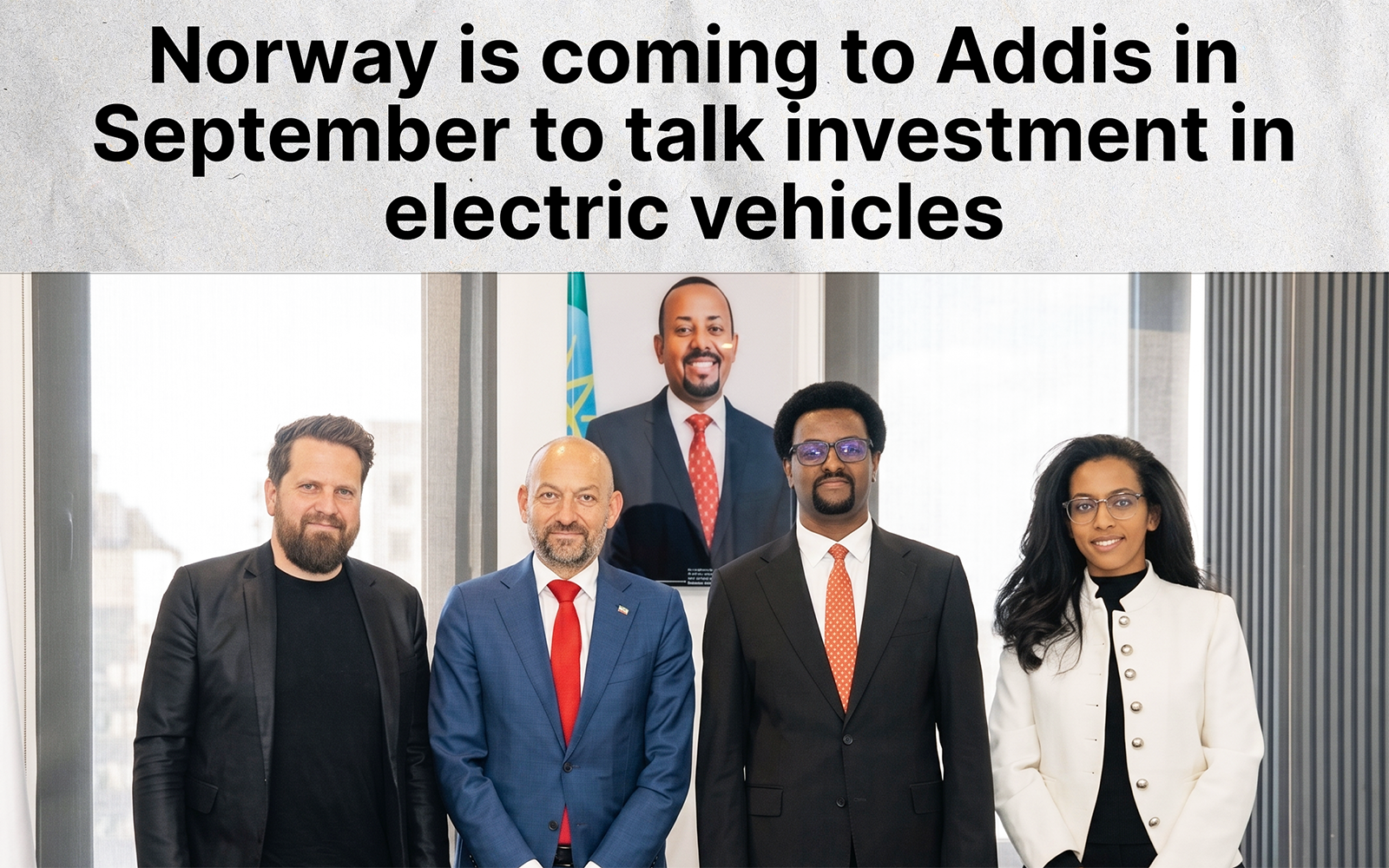
In 2025, 95.9 percent of all new cars registered in Norway were fully electric. In December of that year, the figure hit 98 percent. Norway — an oil-producing country of 5.5 million people — has done what no other nation has managed: it effectively ended the internal combustion engine as a consumer product within a single generation of policy. That country’s ambassador to Ethiopia sat down with the Ethiopian Investment Commission on June 2, 2026, to discuss investing in Ethiopia’s e-mobility sector. The distance between those two realities is the story.
Norway did not get to 96 percent EV market share by accident or by wealth alone. The transition was built on a consistent 30-year policy stack: steep purchase taxes on combustion cars, zero VAT on EVs, reduced tolls, cheaper ferry fares, free municipal parking, and a charging infrastructure investment that began before the cars existed to use it. The lesson Norway carries into any investment conversation is not just the technology — it is the policy sequencing that made adoption inevitable rather than aspirational. Ethiopia’s starting point is a different order of challenge. Petrol in Addis Ababa costs 167 Birr per litre, the national grid runs on over 90 percent hydropower — the cleanest possible source for EV charging — and the government has introduced duty exemptions on electric vehicle imports. The infrastructure for a green transport system is partially in place. What is missing is the investment, the charging network, and the consumer financing model that makes an EV affordable on an Addis salary.
The Ethiopian Investment Commission meeting on June 2 was not a transaction. It was a signal. Commissioner Dr. Zeleke Temesgen highlighted that the government has introduced favourable policies to promote investment in the e-mobility sector and is actively working to develop the necessary infrastructure, inviting Norwegian investors to engage directly. The Nordic–Africa EV Summit, scheduled for Addis Ababa in September 2026, will bring together government officials, investors, and industry leaders from both regions to move the conversation from signal to term sheet. For Norwegian investors, Ethiopia presents a specific proposition: a large, young urban population, a hydropower grid that makes EV charging genuinely green, a government with both the political will and the IMF-backed reform momentum to honour long-term investment frameworks, and a fuel import bill — currently consuming significant foreign exchange at 167 Birr per litre — that creates a structural incentive to electrify transport at scale.
The comparison that matters for an Ethiopian reader is not with Norway’s showrooms. It is with the economics of the shift. Norway’s EV transition was driven not primarily by incentives but by making petrol progressively more expensive relative to electricity. The petrol price in Ethiopia has done that work already — not by policy design but by Birr devaluation and global oil shocks. A minibus taxi operator in Addis running on petrol at 167 Birr per litre faces a monthly fuel bill that has nearly doubled in two years. The economic case for electric minibuses — charged overnight from hydropower at a fraction of the fuel cost — is not theoretical. Electric two-wheelers and three-wheelers are already operating in Addis Ababa, with locally assembled models entering the market. The September summit’s task is to close the gap between that early-stage reality and the capital that would scale it.
Norway took 30 years to reach 96 percent. Ethiopia will not take the same path — it will either leapfrog faster, as mobile banking leapfrogged physical bank branches, or it will stall at the demonstration stage while the fuel bill keeps rising. The difference between those outcomes is not technology. It is whether the September summit produces a financing model that makes an electric vehicle accessible to the Addis taxi driver, the logistics operator, and the last-mile delivery company — not just to the government fleet. Norway’s own EV association is clear on this: the transition succeeded because it was never just about the car. It was about making the alternative cheaper than the status quo. At 167 Birr per litre and rising, Ethiopia is already there on the cost side. The investment is what completes the equation.