
Mobilizing the Masses: The Massive Push to Educate Voters for Ethiopia’s High-Stakes Election
Before June 1, Ethiopia deployed students across the country and flooded social media with ballot guides. In a nation where fewer than half of adults are formally literate, the design of democracy itself had to change.
Asking fifty million people to cast a ballot is one thing. Asking them to cast two — one for a seat in the House of Peoples’ Representatives and a second for their Regional Council, across 42 competing parties, 10,438 candidates, party logos, individual photographs, and names printed in the script of their region — is a different order of problem entirely. Ethiopia’s adult literacy rate sits at roughly 51 percent, meaning nearly half of registered voters cannot reliably read the words on the paper in front of them. The election worked anyway. That required a plan.
The gap is not for lack of effort. The government has made primary school expansion a central pillar of its domestic agenda — gross enrollment has risen sharply over two decades — but the pipeline takes generations to close. Between 23 and 35 percent of primary-school-age children remain out of school, with the highest rates in agro-pastoral regions: Somali, Afar, Gambella. These are precisely the constituencies where civic engagement has historically been lowest and where a miscast ballot, or no ballot at all, is most likely to go unnoticed and unreported. The election board knew this going in.
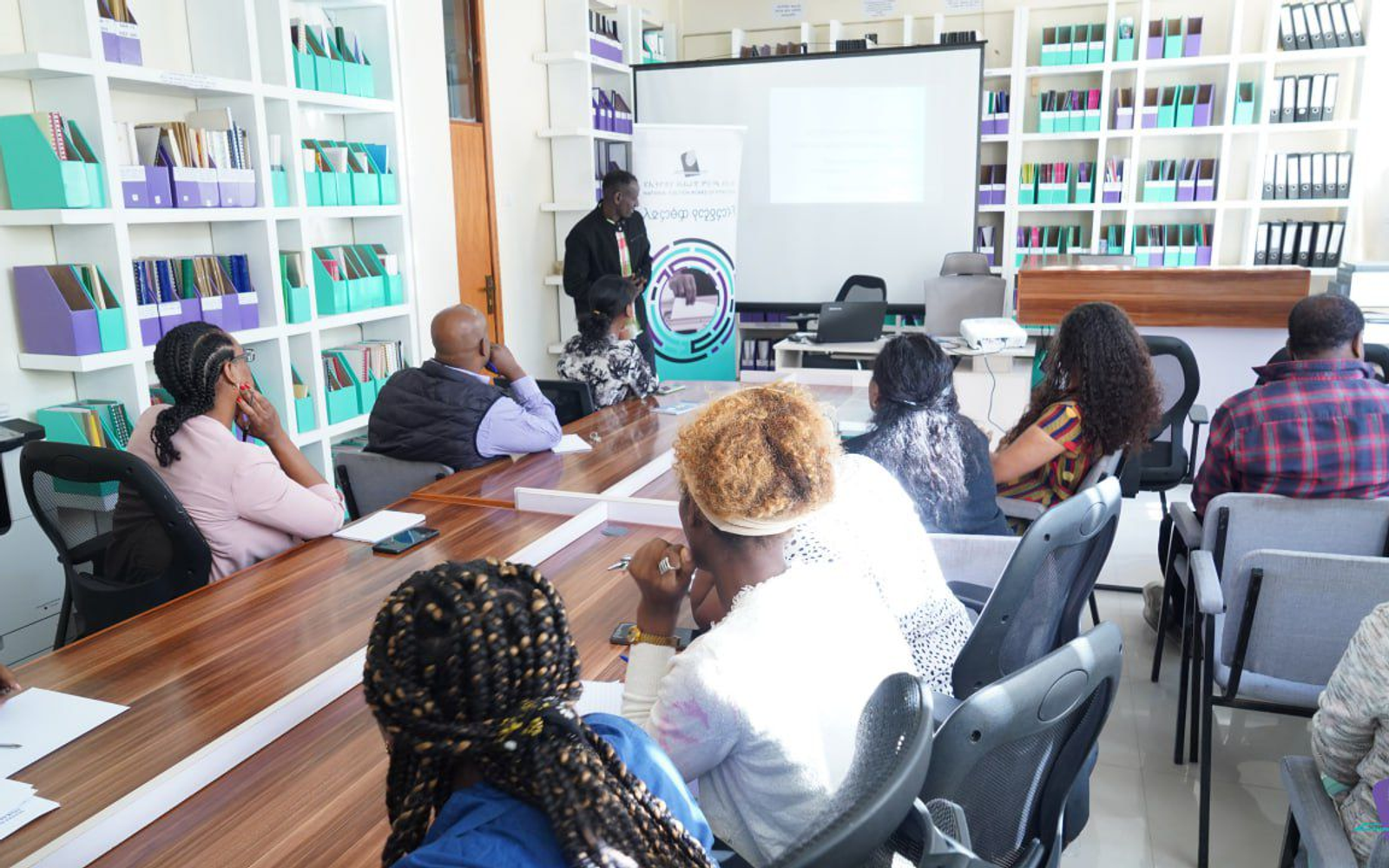
The response was physical first. NEBE’s Civic and Voter Education department trained and deployed youth volunteers in collaboration with Regional Branch Offices as part of a nationwide outreach push ahead of June 1. University students — drawn from campuses across the country and sent out into communities beyond their own cities — were among the most visible element of that effort, conducting face-to-face sessions on how the two-ballot system works: which paper elects a federal MP to the 547-seat House of Peoples’ Representatives, and which elects a representative to one of 11 regional councils or two city councils. The ballot, under NEBE’s own guidance, permits a mark, a tick, or a fingerprint — a deliberate accommodation for voters who cannot write. The students’ job was to make sure people knew that before they walked in.
In parallel, NEBE built its digital education campaign around the specific constraints of its audience. The ballot itself was designed for a multilingual, multi-literacy electorate: every candidate appears with a party logo, a personal photograph, and a name, with the order determined by a public lottery held on March 23, 2026. A voter who cannot read Amharic or Afaan Oromo can still identify their candidate by face. The social media campaign — run across Facebook, Telegram, and TikTok, in Amharic, Afaan Oromo, Somali, Tigrinya, and other languages — used short video formats to walk viewers through the two-vote process, explaining the difference between the federal and regional ballot, showing what a correctly marked paper looks like, and demonstrating the fingerprint option. 169 civil society organisations were licensed by NEBE to run voter education activities on the ground, adding a further layer of community-level reach.
The operational infrastructure behind the education effort is worth naming. Nearly 195,000 election workers were deployed nationwide — for polling station operations, voter verification, logistics, and constituency management. Special registration mechanisms were established for university students, internally displaced persons, and military personnel, groups whose mobility or circumstances make standard polling station access difficult. Universities negotiated academic calendar adjustments to allow students to travel to their home constituencies to vote. The election board held orientation workshops for civil society partners as far back as February. The point is that voter education in 2026 was not a pamphlet dropped at a polling station. It was a months-long, multi-channel, multi-language, multi-format programme that treated civic illiteracy as a logistical problem rather than a personal failing.
What this election tested, beyond who wins which seat, is whether the design of democratic participation can outpace the pace of formal education. Ethiopia’s literacy rate has climbed from 27 percent in 1994 to just over 51 percent today — a generation of investment that is still, by definition, incomplete. The ballot logo, the student in the village, the TikTok video in Somali: these are not workarounds. They are the architecture of inclusion for a country that cannot wait for the school system to catch up before it asks its citizens to govern themselves. Whether the institutions that inherit June 1’s mandate invest in deepening that architecture — or simply harvest the turnout number and move on — is the question that the next five years will answer.