Ethiopia Will Guarantee State Company Contracts to Attract Infrastructure Lenders
New rules target the "bankability" hurdle that stalled $1.2 billion in geothermal and solar investments under IMF borrowing limits, giving foreign banks the legal safety net needed to finance private mega-projects.

After nearly seven years of keeping its checkbook locked away, Ethiopia has reopened the door to sovereign guarantees for major private investors. Through the newly published Council of Ministers Regulation No. 590/2026, the federal government has authorized the Ministry of Finance to issue binding compensation commitments—widely known in global finance as sovereign guarantees—for strategic infrastructure and industrial projects. In plain terms, if a state-owned enterprise breaks a commercial contract, or if a sudden government action wipes out a project’s value, the Ethiopian Treasury is now legally empowered to step in and cover the investor’s losses.
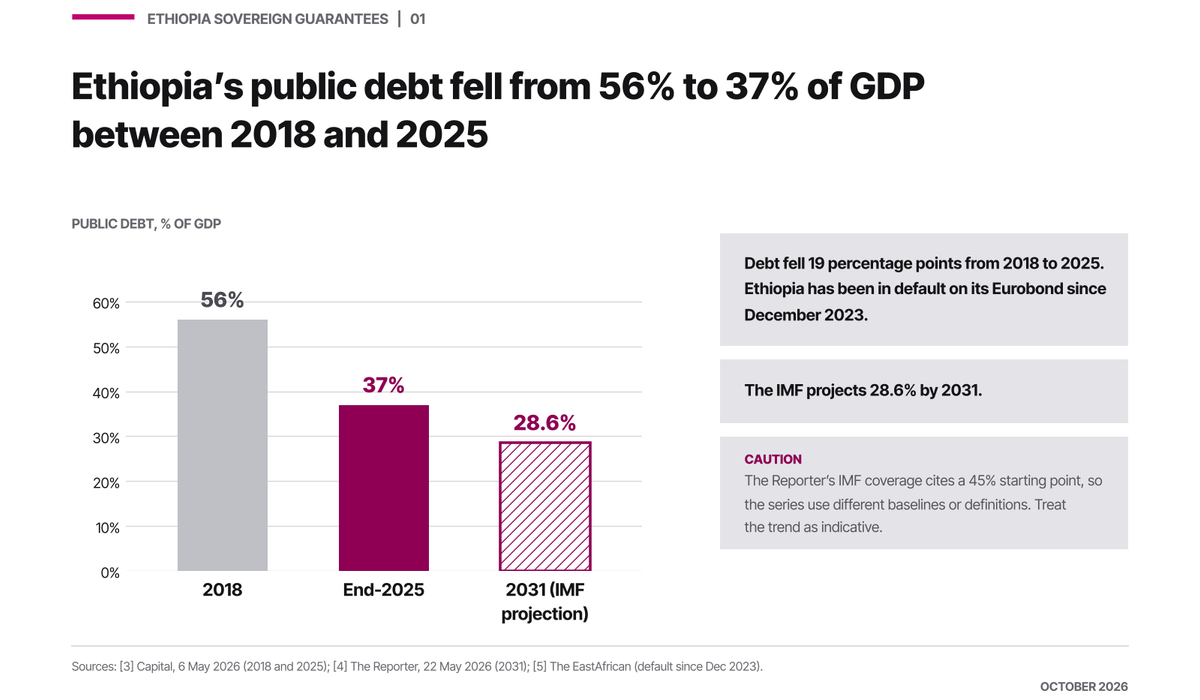
The new law ends a seven-year freeze that began in 2018. For over a decade prior, Addis Ababa fueled its state-led infrastructure boom by handing out blanket sovereign guarantees to back billions of dollars in loans taken out by state-owned enterprises. When several state corporations struggled to repay those loans—eventually forcing the government to transfer more than 582 billion Birr in troubled state-enterprise debt into a dedicated state liability agency—Ethiopia hit severe debt distress. Under pressure from the International Monetary Fund (IMF) and the World Bank starting in 2019, the Ministry of Finance halted new sovereign guarantees and froze non-concessional foreign borrowing.
While that freeze stopped the state from piling on more public debt, it created an unintended trap for private investors. When Ethiopia pivoted to Public-Private Partnerships (PPPs) in 2018, the goal was to have private companies use their own money to build power plants, highways, and logistics hubs. Yet a glaring 17-year legal gap stood in the way: although Article 50(1) of the Financial Administration Proclamation No. 648/2009 and the 2020 Investment Proclamation allowed the Finance Minister to issue investor protections in principle, the Council of Ministers never passed the specific regulation needed to make that power work in practice.
Without a clear legal rulebook, dozens of flagship projects stalled in bureaucratic limbo between 2019 and 2025. Imagine a private energy developer wanting to spend $500 million building a solar or geothermal plant in Ethiopia. Because state-owned Ethiopian Electric Power controls the national grid, the developer has only one buyer. When the developer goes to international banks to borrow the construction money, lenders ask a simple question: What happens if the state utility runs short of dollars and stops paying for the electricity? Because the Ministry of Finance could no longer issue guarantees, foreign banks labeled Ethiopian infrastructure "unbankable" and refused to wire the funds—leaving major solar tenders in Gad and Dicheto, as well as $1.2 billion in geothermal deals at Corbetti and Tulu Moye, stuck on paper for years.
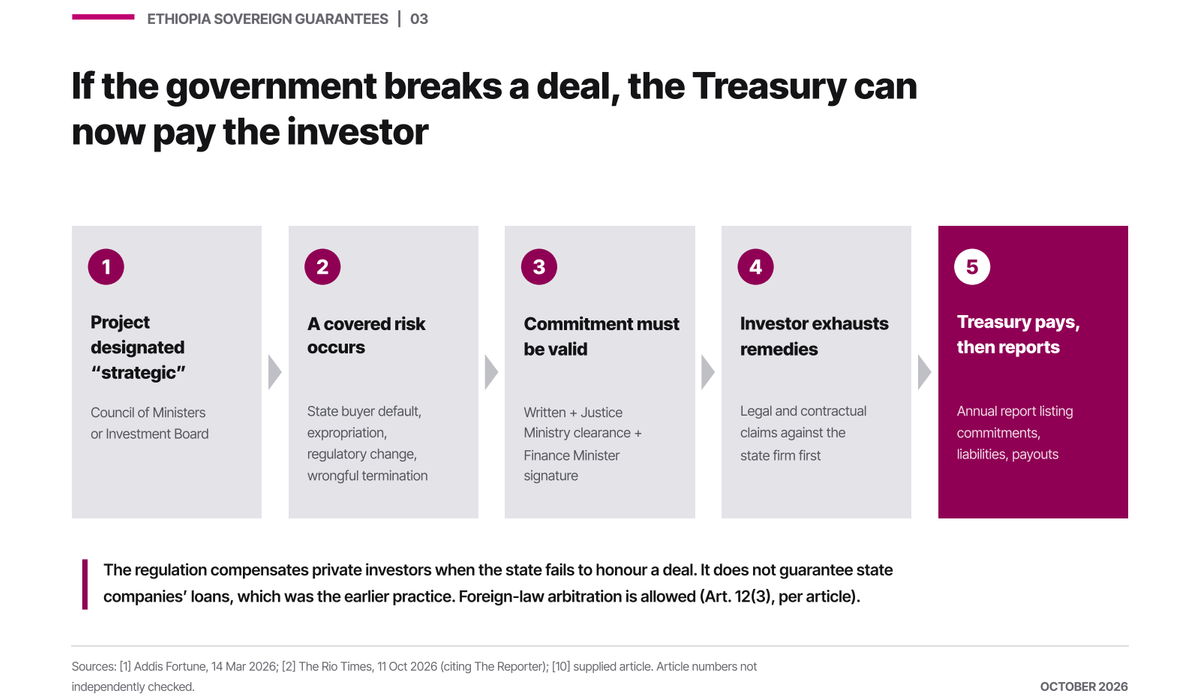
Regulation No. 590/2026 is designed to break that exact logjam without violating Ethiopia’s strict IMF debt limits. Instead of guaranteeing loans for state-owned companies, the new rulebook focuses strictly on compensating private investors if the government fails to honor its side of a deal. To qualify, a project must first be designated as "strategic" by the Council of Ministers or the Ethiopian Investment Board based on its ability to bring in new technology, boost exports, or build regional connectivity.
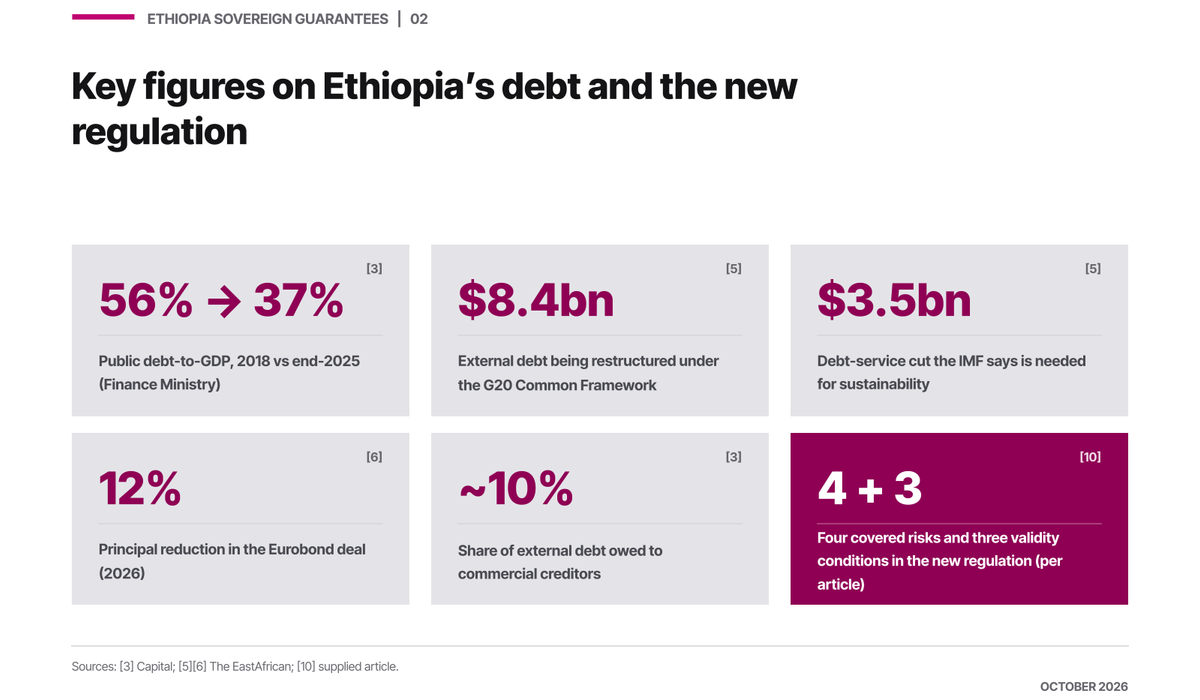
According to legal analyses of the new regulation, once a project is approved, the Ministry of Finance can protect investors against four major risks:
State buyer defaults: When a state-owned utility or public enterprise fails to pay for power, water, or infrastructure services it contracted to buy under an off-take agreement.
Expropriation and nationalization: Direct seizure of private project assets by the government.
Regulatory deprivation: Sudden changes in laws, rules, or tariffs that destroy a project's financial viability.
Termination payouts: Covering the fair market value of assets, direct operating costs, and agreed liquidated damages if a state contract is unlawfully canceled.
Crucially, the regulation gives foreign lenders the legal safety valve they have demanded for years: under Article 12(3), investors and the government can agree to settle disputes through international arbitration under foreign governing law, removing fears that a local court might favor the state in a multi-million-dollar dispute.
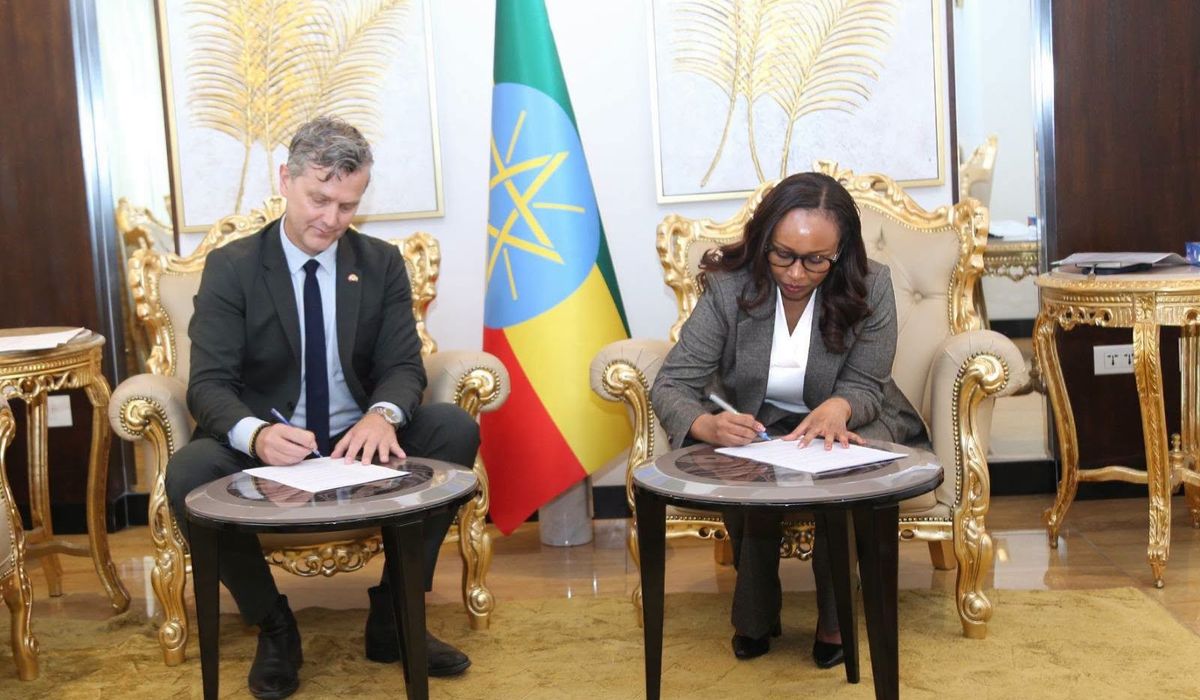
To make sure Ethiopia never repeats the reckless guarantee spree of the past, the law builds a high wall around the national treasury. Under Article 12(2), a sovereign commitment is legally void unless it meets three strict conditions: it must be drafted in writing, receive prior written legal clearance from the Ministry of Justice, and carry the personal signature of the Minister of Finance.
Furthermore, investors must exhaust every legal and contractual remedy against the state enterprise before claiming a single Birr from the Ministry of Finance, and guarantees are immediately canceled in cases of investor fraud, gross negligence, or project abandonment. Finally, the Finance Minister must report every active guarantee and payout to Parliament each year—giving global investors the backing they need while keeping Ethiopia’s national balance sheet out in the open.