
Draft Law to Make School Meals Mandatory in Ethiopian Government Schools Sent to Parliamentary Committee
A draft proclamation before the House of Peoples’ Representatives would mandate nutritious school feeding from pre-primary through middle school.
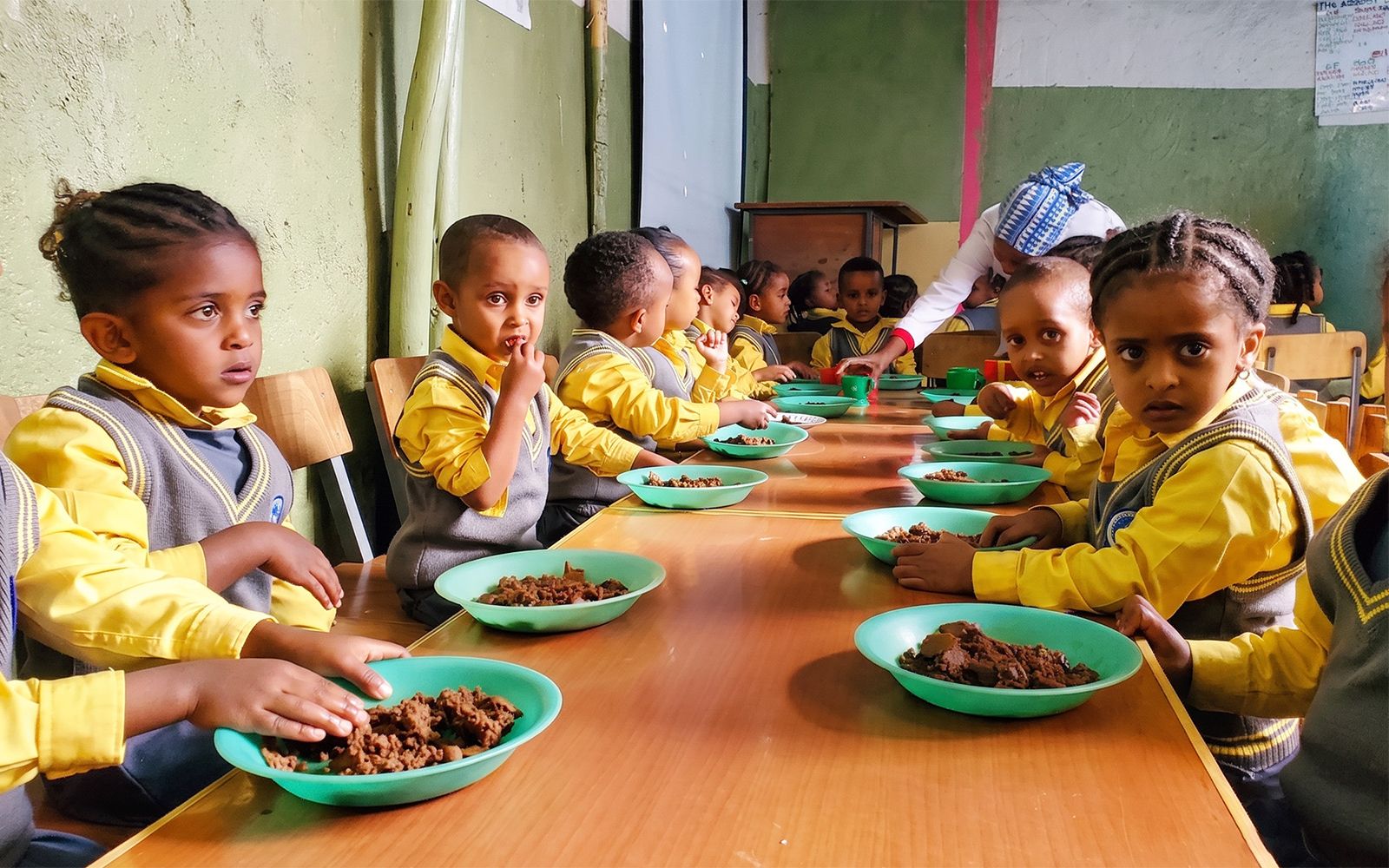
If you have sat in an Ethiopian government school classroom, you know what hunger looks like from the front of the room. It looks like a child who arrived at 7 a.m. having eaten nothing since the previous day. It looks like a lesson that loses its audience by 10 a.m. not because the teacher is poor, but because the student’s body has begun cannibalising itself for energy. Forty percent of Ethiopian children — 6.6 million — suffer from stunting, the condition produced by chronic undernutrition in which a child’s physical and cognitive development is permanently curtailed. That figure has been in every nutrition report for a decade. What is new, as of this week, is that a law has been drafted to do something about it inside the school gate.
The Food System and Nutrition Draft Proclamation, now referred to the House of Peoples’ Representatives Standing Committee, mandates that the Ministry of Education implement nutritious feeding programmes in all government schools from pre-primary through middle school level. It also assigns budget, quality control, and nutrient supply responsibilities to 13 government institutions — the Ministries of Finance, Health, Agriculture, and Industry among them — and places a duty to cooperate on all citizens. The breadth of institutional assignment is significant: it signals that the architects of the law understand that a school feeding programme is not a Ministry of Education problem. It is a supply chain problem, a fiscal problem, an agricultural procurement problem, and a health delivery problem simultaneously. The question that the standing committee scrutiny will need to answer is whether assigning responsibility to 13 institutions creates coordination or diffuses accountability so widely that no single body can be held to the outcome.
The malnutrition context the law is responding to is documented and specific. UNICEF estimates that 5.8 million Ethiopian children under five currently suffer from stunting due to chronic malnutrition, with undernutrition associated with 45 percent of all child deaths under the age of five in the country. A 2024 study in Wolaita Zone found that children in schools with feeding programmes showed stunting rates of 13.7 percent, compared to 21.6 percent in schools without them — a difference of nearly eight percentage points produced by a meal. The evidence that school feeding reduces stunting is not contested. What has been contested, for years, is who pays for it, who supplies it, and who is accountable when the food does not arrive.
Ethiopia is not starting from zero on this. The government’s Home Grown School Feeding programme, operational since 2019 in selected woredas, purchases food from local smallholder farmers and supplies it directly to school kitchens, creating a demand signal for local agricultural production while delivering nutrition to students. WFP has been a technical partner in the programme’s design. The model works where it operates — but it has never been fully national in scale, and it has never been underpinned by a legal mandate that compels the Ministry of Finance to budget for it. That is what the draft proclamation provides: the legal architecture that turns a programme into a right, and a budget line into an obligation rather than a discretionary allocation.
The fiscal dimension is the critical variable. Ethiopia’s education budget has expanded significantly over the past decade, but it competes for allocation against health, infrastructure, defence, and debt servicing inside a fiscal envelope that the IMF’s Extended Credit Facility has placed under structural constraint. The fifth ECF review, concluded on June 3, requires Ethiopia to increase cumulative tax revenue by 47 percent to $6 billion. A mandatory school feeding programme at national scale — covering millions of children across 35,000-plus government schools — requires procurement budgets, kitchen infrastructure, and supply logistics that will test the Ministry of Finance’s appetite for a new recurrent expenditure line at precisely the moment fiscal consolidation is mandated. The 13-institution framework in the proclamation may be as much a budget-sharing mechanism as a coordination mechanism.
The agricultural linkage embedded in the law deserves separate attention. If the Ministry of Agriculture is assigned nutrient supply responsibility, the procurement model that follows from that assignment will determine whether the programme feeds children or feeds import brokers. Ethiopia produces enough teff, sorghum, maize, and pulses to supply a national school feeding programme domestically if the procurement mechanism is designed for smallholder sourcing rather than bulk commercial contracts. The Home Grown model has demonstrated this at woreda level. Whether the draft proclamation’s institutional framework for agriculture translates into a nationally scaled version of that model, or defaults to centralised procurement from larger commercial suppliers, is a design question the Standing Committee should put directly to the Ministry of Agriculture before the law passes.
The draft proclamation before the House of Peoples’ Representatives is a law built on a number — 6.6 million — that Ethiopia has known for years. The question the Standing Committee must answer is not whether to act. The evidence that a school meal reduces stunting by eight percentage points is not in dispute.