
Addis is converting 2,000 diesel buses to run on Ethiopian gas.
Rising fuel costs, a widening subsidy bill, and global supply disruptions have pushed Addis to convert 2,000 city buses to run on Ethiopian gas. The question is who holds the margin when the fleet finally runs on it.
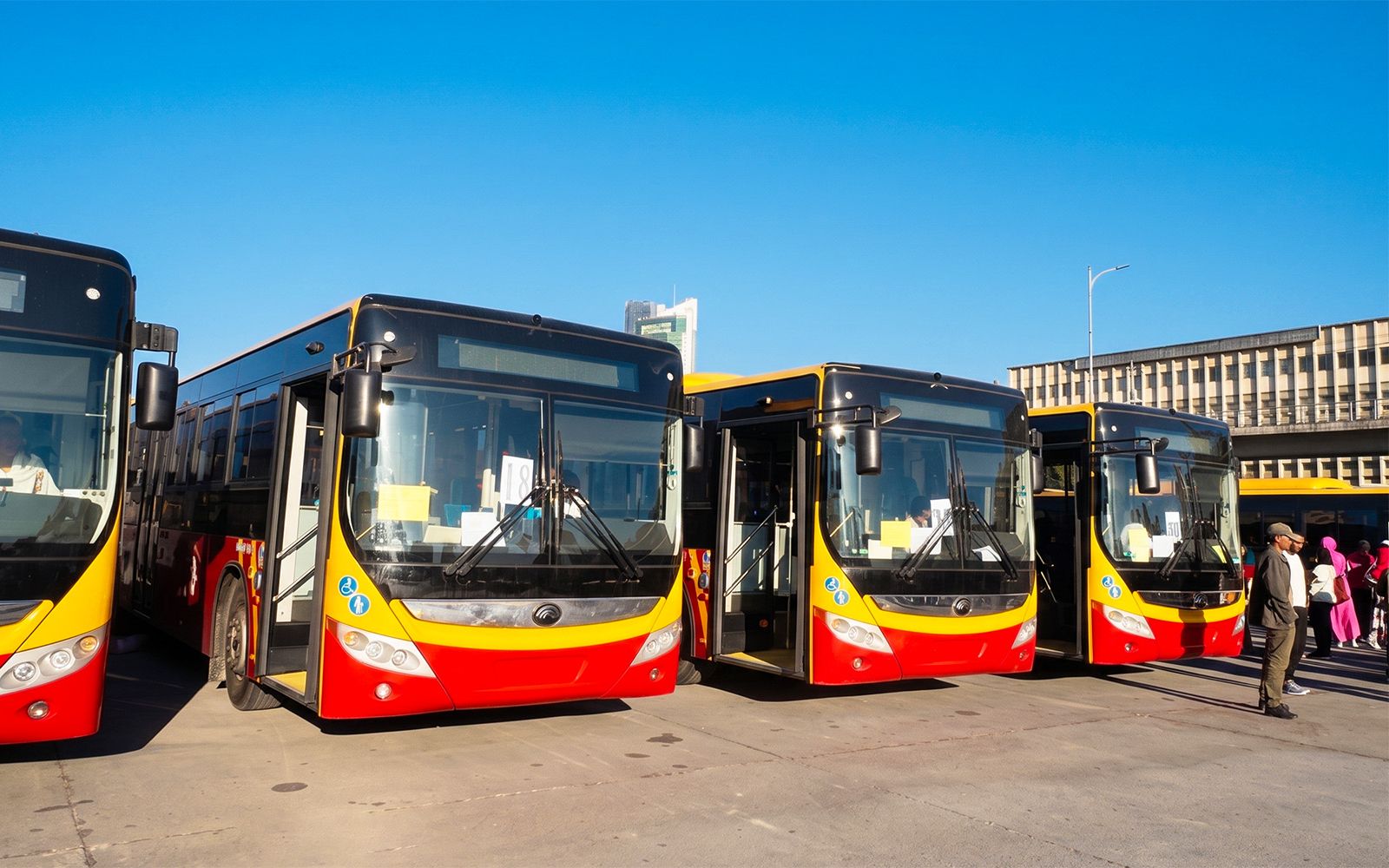
Every day, Addis Ababa's city bus fleet burns roughly 150,000 litres of diesel to move 1.1 million passengers across the capital — enough to fill around 3,000 Toyota Corolla tanks every single day, just to keep the buses running.
That fuel is imported through Djibouti, paid for in dollars, and now costs 180 birr a litre — roughly what a minimum-wage worker in Addis earns in a full day of work, for one litre. Two years ago that same litre cost 91 birr. The bus that completed Ethiopia's first oil-to-gas road test on 12 May was not, primarily, an environmental milestone. It was an arithmetic response to a fuel bill that has become one of the most politically explosive line items in the Ethiopian federal budget.
Ethiopia has no national minimum wage. The median monthly wage, according to an ILO study published in 2024, stands at 3,000 birr. At current retail prices, that income buys roughly 16 litres of diesel. A bus driver transporting a thousand commuters a day earns, in fuel-litre terms, less than a full tank of the vehicle he operates. The numbers frame why the Addis Ababa City Administration's 1.4 billion birr plan to convert 1,200 public buses to gas is being treated not as a green infrastructure project but as a fiscal intervention — one of the few instruments the city administration has to bring operating costs below the level at which the bus network haemorrhages money.
The structural conditions behind that crisis are well documented. Ethiopia spent approximately $4 billion on imported petroleum products in the 2023–24 fiscal year, according to Prime Minister Abiy Ahmed, against total goods exports of around $3 billion — meaning fuel imports alone exceeded the country's entire export revenue. The government absorbed the gap through subsidies that, as of April 2026, had overshot their budget allocation by 172 percent, reaching 272 billion birr. In January 2025, Prime Minister Abiy told parliament that his government was covering 28 birr per litre in subsidy on a fuel whose global market price was 129 birr — a transfer running at tens of millions of birr a day that even he described as unsustainable.
Then the Strait of Hormuz closed. On 28 February 2026, joint US-Israeli strikes against Iran triggered what the IEA's April 2026 oil market report described as the largest oil supply disruption in recorded history — a 10.1 million barrel-per-day production collapse that sent crude prices past $115 a barrel. For Ethiopia, the impact was immediate and concrete: 180,000 metric tons of petroleum products en-route to the country were stalled. Diesel and jet fuel coverage fell to 50 percent of required levels. The Ministry of Trade confirmed to parliament that alternatives would have to be sourced from spot markets — at prices requiring upfront dollar payments that the National Bank of Ethiopia could not easily supply.
It is in this context that GCL Africa Industrial Group's bus conversion project acquires a significance that its press release framing — China-Africa cooperation, green energy, Belt and Road — largely obscures. GCL is not a newcomer to Ethiopia's gas economy. Its parent, China's GCL Group, has operated in the Ogaden Basin since at least 2013, when it was awarded a concession by the name Poly-GCL Petroleum Group to develop the Calub and Hilala gas fields in the Somali Region. The original plan was export-oriented: a 767-kilometre pipeline to Djibouti and a Red Sea LNG terminal that would have made Ethiopia a gas exporter. That plan was cancelled in 2025 after persistent financing shortfalls and implementation delays led the Ethiopian Energy Outlook to formally close the file.
What replaced it is a domestic utilisation strategy. In October 2025, Prime Minister Abiy Ahmed inaugurated the first phase of the Ogaden Liquefied Natural Gas Project at Calub — a facility GCL built, capable of processing 200,000 cubic metres of natural gas per day and producing 50,000 tonnes of LNG annually. A second phase, currently under construction, will expand annual capacity to 1.33 billion litres. The Calub project also anchors a $2.5 billion fertiliser plant — a joint venture between the state-owned Ethiopian Investment Holdings and Aliko Dangote's group — to produce three million tonnes of urea annually from the same gas field, via a 108-kilometre pipeline. GCL built the upstream supply. It is now contracted to build the downstream consumption — the bus fleet that will burn what Calub produces.
The conversion project itself is structured around speed. Five workstations at a 24/7 retrofit centre are targeting an average of ten buses per day, with the stated goal of converting all 2,000-plus public buses in Addis Ababa within eight months. The Birr Metrics report on the city administration's 1.4 billion birr allocation — sourced from Transport Bureau head Yabibal Addis — puts the per-bus conversion cost at roughly 1.17 million birr, or approximately $7,800 at current exchange rates. A CNG filling station has already been constructed at the Kality Depot to support the pilot fleet. The GCL announcement does not break out who bears the capital cost of the conversion kits, who owns the refuelling infrastructure, or what the pricing mechanism for compressed natural gas will be once the fleet is running at scale.
Those omissions matter economically. The savings case for the conversion rests on a gas price that, according to Ethiopian Broadcasting Corporation reporting citing energy expert Adonay, will be below the price of a single litre of petrol — and on a performance ratio in which one kilogram of CNG delivers 34 kilometres of range. At current diesel prices of 180 birr a litre, a bus that consumes 35 litres per 100 kilometres is spending 630 birr per 100 kilometres on fuel. If CNG can deliver the same range at a cost below 180 birr per kilogram equivalent — and if the Calub supply chain is stable enough to maintain pressure at Addis Ababa's altitude — the operating arithmetic improves sharply. The Transport Bureau's daily bus revenue has already doubled to 10 million birr following last year's reforms; cutting the fuel line on the cost side of that ledger would make the system's economics structurally different.
The parallel with Egypt is instructive but imperfect. Egypt converted more than 2,262 diesel buses in Cairo and Alexandria through a partnership between bus OEM Geyushi and the Ministry of Petroleum's Cargas and Gastec divisions. Egypt's advantage was infrastructure: it already operates more than 800 CNG filling stations, built over decades of domestic gas exploitation. Ethiopia has one, at Kality. The African CNG and LPG vehicle market is projected to reach $2.16 billion by 2030, growing at a 6.94 percent CAGR, with retrofit kits accounting for 77 percent of current installations — a market structure that favours vendors with kit supply chains and first-mover infrastructure positions. GCL, which controls the Ogaden gas supply, the bus conversion contract, and the Kality refuelling station, is positioned to hold all three layers of that value stack simultaneously.
The City Administration has not published the contractual structure of the GCL arrangement — whether it is a government-to-government grant, a commercial contract with the state-owned Anbessa bus enterprise and its successor city bus companies, or a build-operate-transfer arrangement over the refuelling infrastructure. Ethiopia banned the import of internal combustion engine vehicles in January 2024, extended the ban to knocked-down assembly kits in 2025, and has positioned itself as the most aggressive adopter of electric transport on the continent — the first country to impose a total ICE import ban. CNG retrofit sits in a curious middle position: cleaner than diesel, carbon-positive compared to electricity generated from the Grand Ethiopian Renaissance Dam, and entirely dependent on a single Chinese concessionaire for its upstream supply. Taxi driver Abdurahman Ali, who switched from a petrol Toyota Vitz to electric and cut his monthly fuel cost from 40,000–50,000 birr to 5,000 birr, made his calculation privately. The city bus network does not have that option yet — its 2,000 vehicles cannot be electrified on an eight-month timeline. Gas is what is available.