
What You Need to Know About the $660M EIH-Dangote Pipeline Restructuring Ethiopia's Fuel Logistics
A shorter route and massive border storage replace a decade of stalled pipeline mega-projects, cutting the capital bill by nearly a billion dollars against the last attempt in 2015.
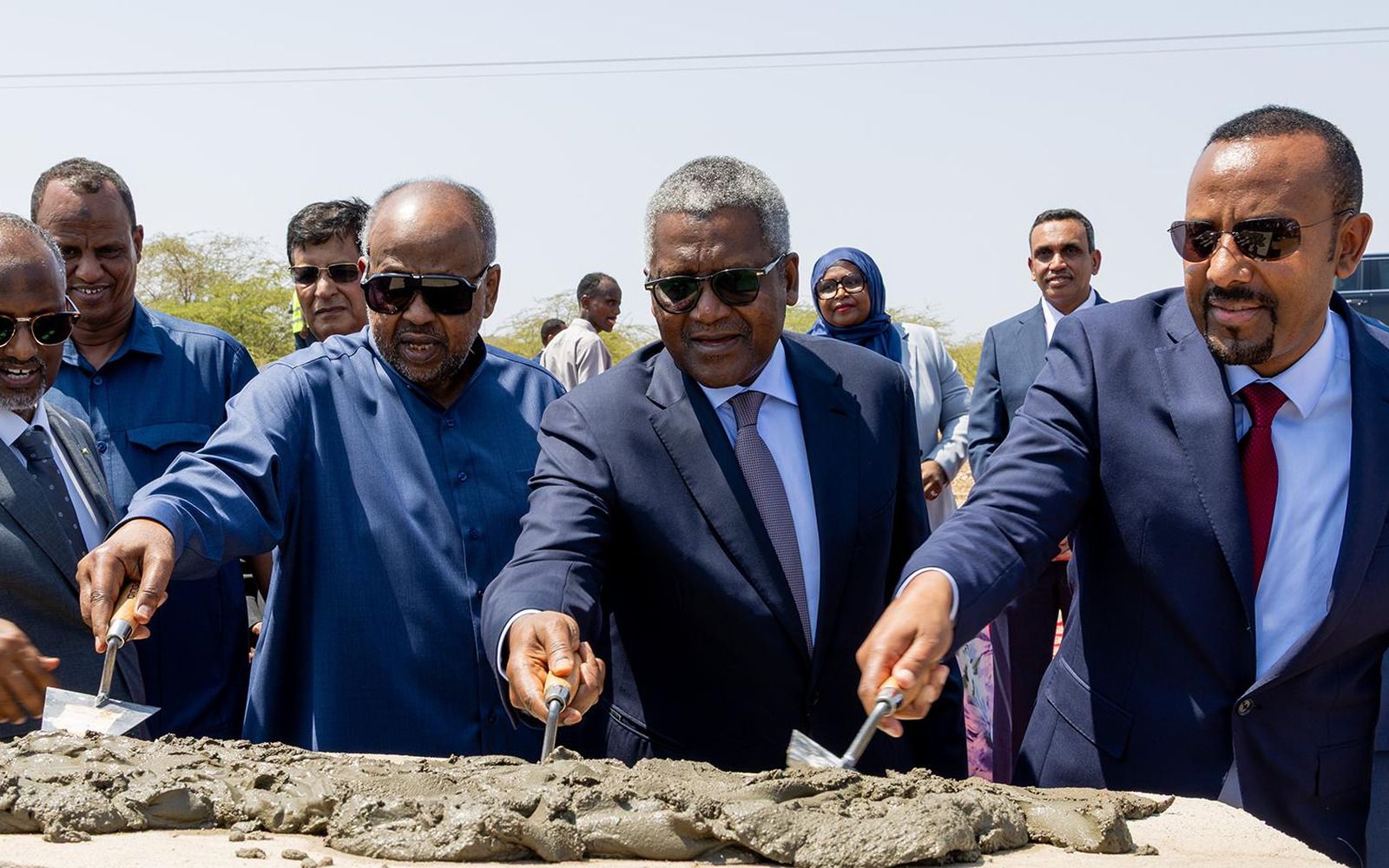
Ethiopian Investment Holdings (EIH) and the Dangote Group broke ground this week on a $660 million joint venture to move refined fuel from Djibouti's coast to the Ethiopian border by pipeline, replacing the road-tanker fleet that has hauled the country's imported fuel for decades. Prime Minister Abiy Ahmed and Djibouti President Ismail Omar Guelleh attended the ceremony alongside Dangote Group leadership, along with financiers including the African Export-Import Bank and the African Finance Corporation.
The project replaces a decade of stalled, far larger pipeline proposals with a much shorter link and two oversized storage depots at either end. Instead of piping fuel deep into the Ethiopian interior, it moves the logistics chokepoint from the Djiboutian coast to Dewele, on the Ethiopian side of the border.
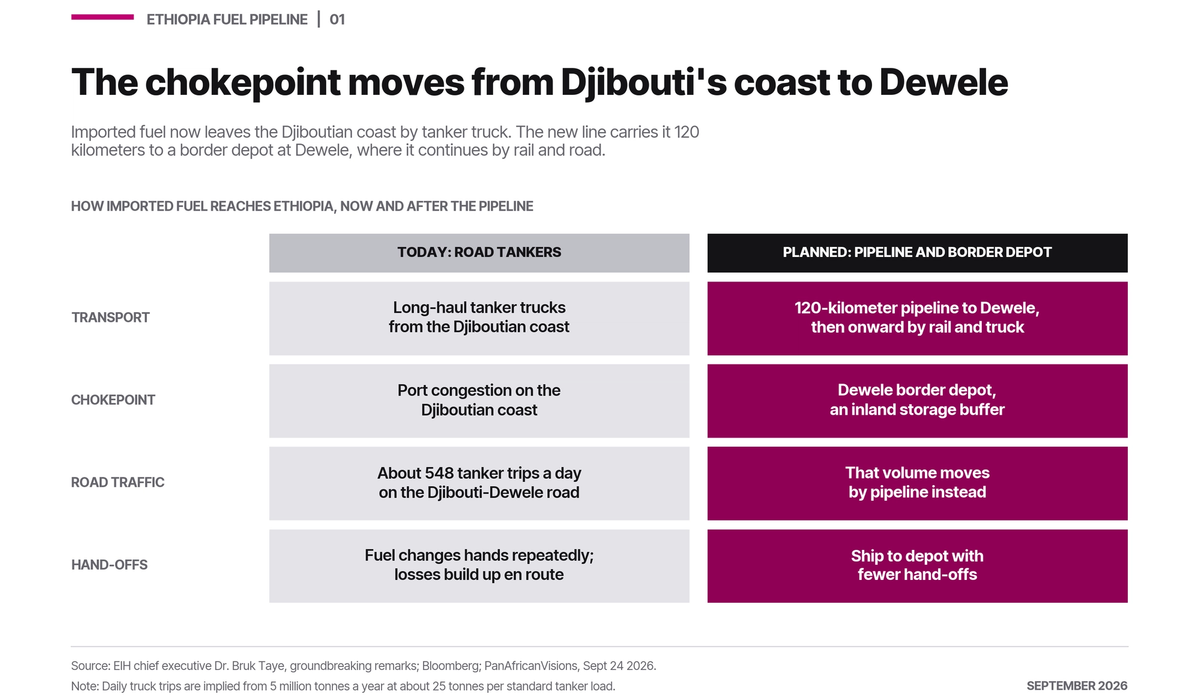
The pipeline runs 120 kilometers from the Damerjog petroleum terminal on the Djiboutian coast to Dewele — a distance close to the length of the Addis Ababa–Adama expressway. At Damerjog, the terminal connects directly into the Damerjog-Nagad railway line and a shared collector system at the port, so fuel moves from ship to depot without passing through a separate trucking stage.
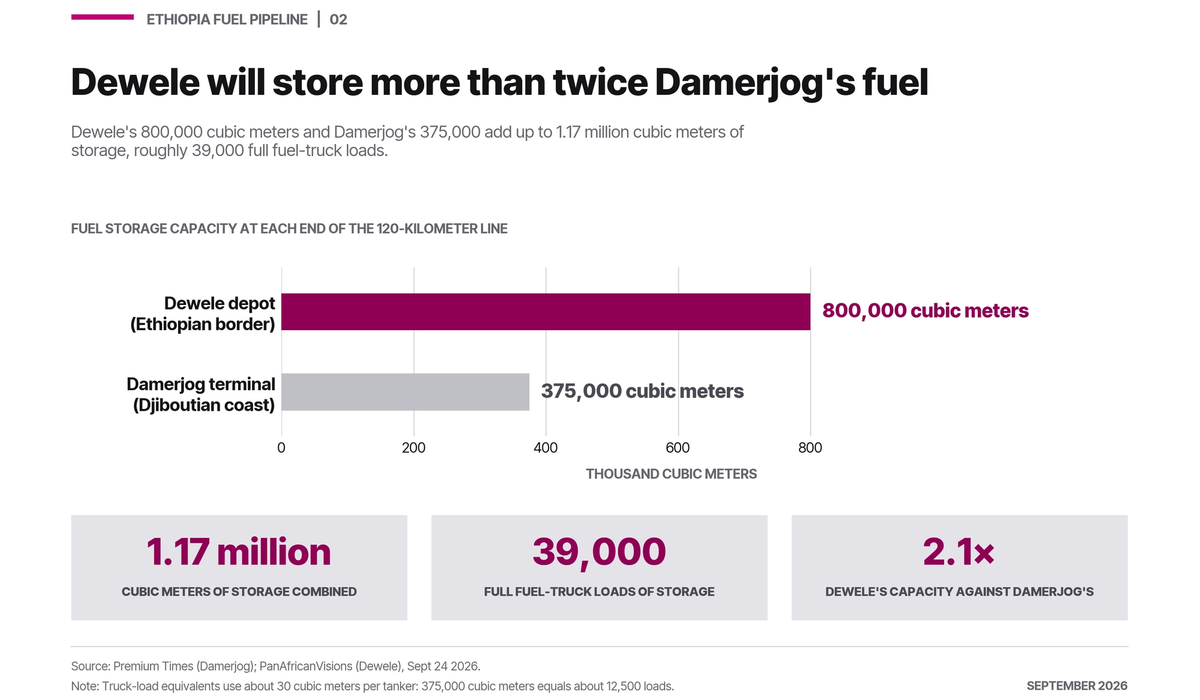
Combined, the two ends of the line will hold 1.17 million cubic meters of fuel — equivalent to roughly 39,000 full fuel-truck loads. Damerjog's share is 375,000 cubic meters (about 12,500 truck loads), sized to process 5 million tonnes of petroleum a year. Dewele's depot is more than double that, at 800,000 cubic meters, and is also being linked to Ethiopia's rail network, so fuel arriving from Djibouti can move onward by both truck and train rather than truck alone.
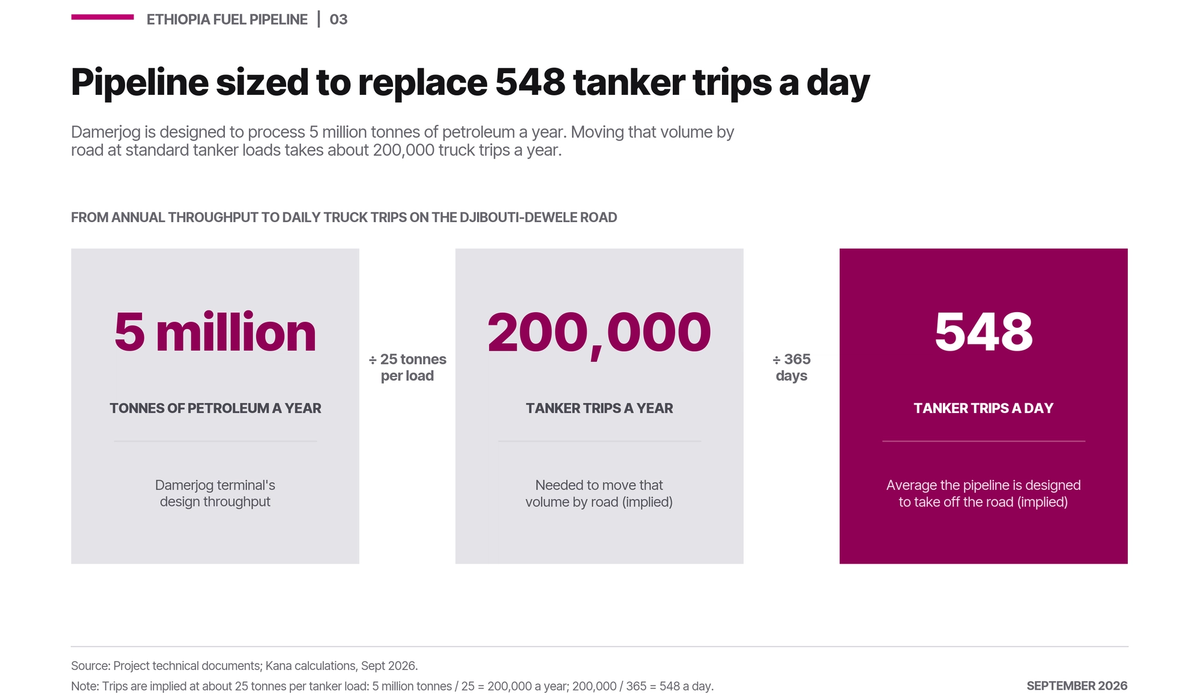
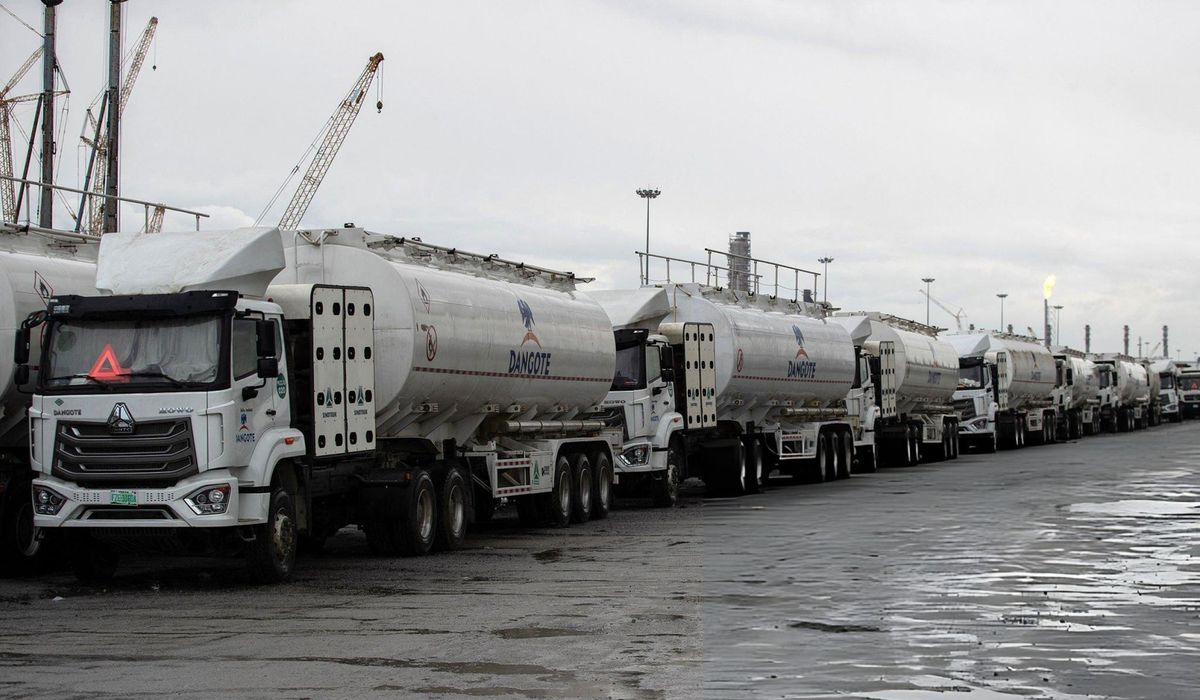
At standard tanker-truck loads, 5 million tonnes a year works out to roughly 200,000 truck trips annually — about 548 a day — that the pipeline is designed to take off the Djibouti–Dewele road corridor.
The project's own materials put commissioning at an aggressive 18 months. At the groundbreaking, however, EIH chief executive Dr. Bruk Taye told Ethiopian broadcasters the pipeline is expected to take two years to complete. He described road transport of fuel over long distances as poorly monitored, with losses and irregularities building up over the length of the journey — the specific problem the Dewele depot and its rail link are meant to remove, by cutting the number of times fuel changes hands between ship and final delivery.
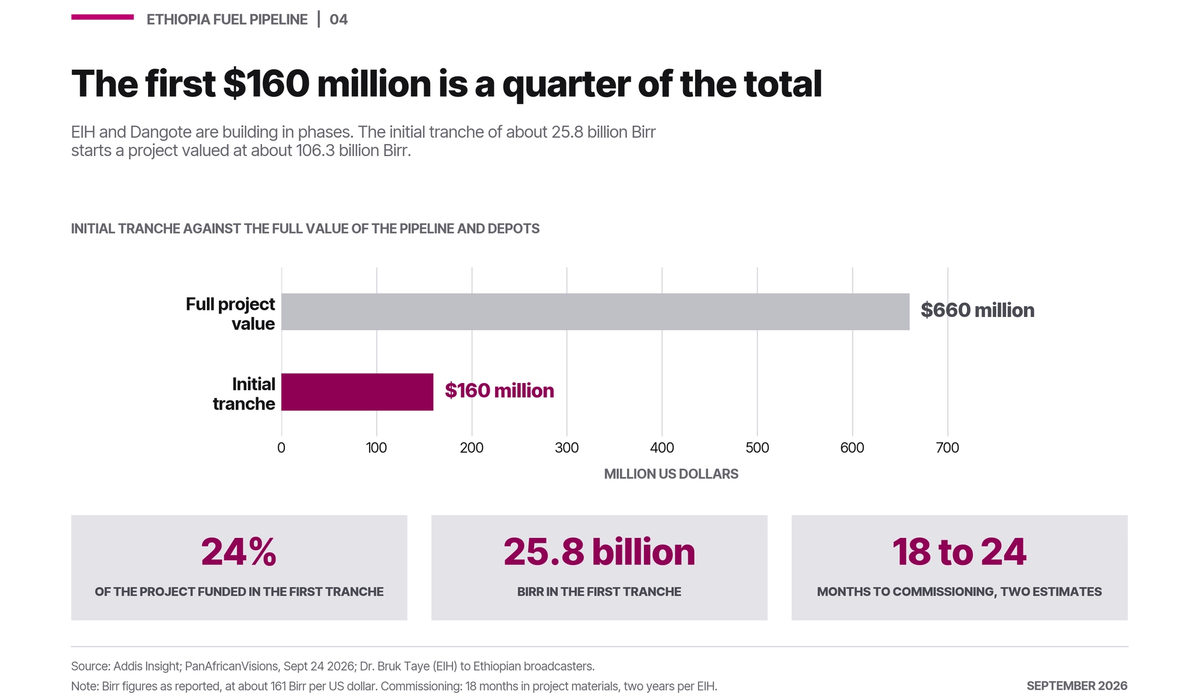
The $660 million investment is being built in phases, starting with an initial $160 million tranche — roughly 25.8 billion birr at current exchange rates, against a full project value of about 106.3 billion birr. It extends a partnership EIH and Dangote opened in August 2025 with a $2.5 billion urea fertilizer complex in Gode (about 402.5 billion birr).
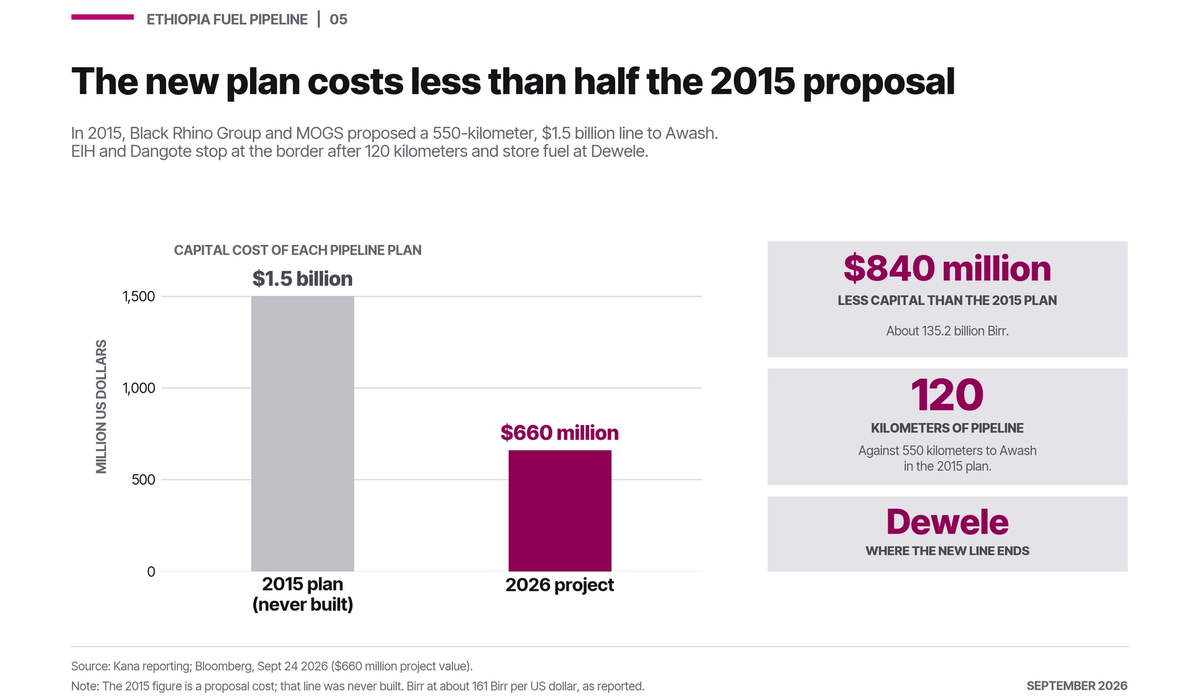
The pipeline route is a marked retreat in scale from the last attempt to solve the same problem. In 2015, the Blackstone-backed Black Rhino Group and MOGS proposed a 550-kilometer pipeline running all the way from Damerjog to Awash in central Ethiopia, at a cost of $1.5 billion (about 241.5 billion birr). That project was never built. By stopping the pipeline at the border and using Dewele as an inland storage buffer instead of extending the line itself, EIH and Dangote cut roughly $840 million (about 135.2 billion birr) off the capital bill while still removing Ethiopia's dependence on Djiboutian port congestion and road haulage for its fuel supply.
Dangote framed the pipeline as one piece of a $50 billion continental investment plan running to 2030. He cited Dangote Cement's current capacity of 55 million tonnes across 11 countries, with a target of 100 million tonnes within about four years, and said the Dangote Petroleum Refinery — which he described as the world's largest single-train refinery — is being expanded toward 1.4 million barrels a day. He pointed to Nigeria's shift from importing cement, fertilizer and petroleum products to exporting them as the template, and said Ethiopia is positioned to become a fertilizer exporter by 2029 on the back of the Gode complex.
For Djibouti, the project is pitched around higher port throughput, added revenue and jobs, and a stronger claim to its existing role as the region's transit hub — the Damerjog rail and collector links are built to keep that traffic flowing through Djiboutian infrastructure even as less of it moves by truck.