
How Ethiopia Plants 800 Million Trees in a Single Day
A year-round supply chain of 120,000 nurseries, pre-dug planting holes, GPS-mapped land, and digital survival tracking produces the conditions for one day's planting.
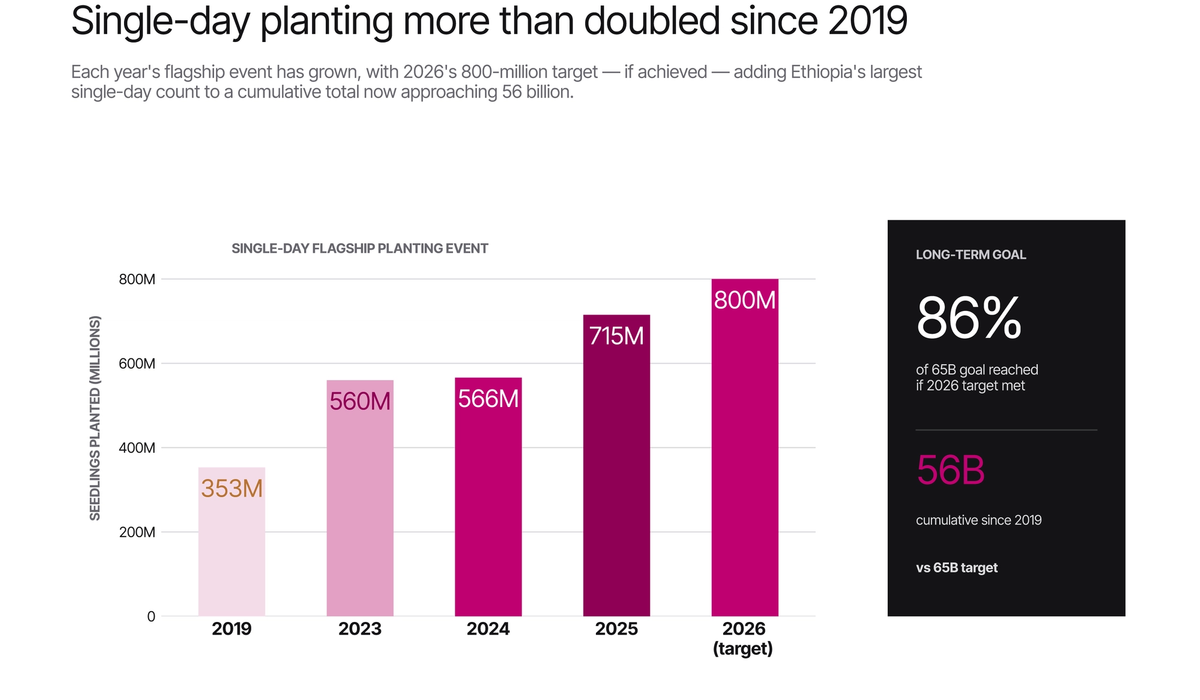
In 2019, Ethiopia planted 353 million seedlings in a single day. In 2023, 560 million. In 2024, 566 million. In 2025, 714.7 million — 21.6 million Ethiopians participating, 355 million seedlings already in the ground before 6 a.m. The 2026 season’s full target is 8 billion seedlings. Achieving it would bring Ethiopia’s cumulative total since 2019 to more than 56 billion, advancing a long-term goal of 65 billion trees. Every year the number grows. Every year the operation behind it grows with it.
THE SUPPLY CHAIN: 120,000 NURSERIES AND 12 MONTHS OF PREPARATION
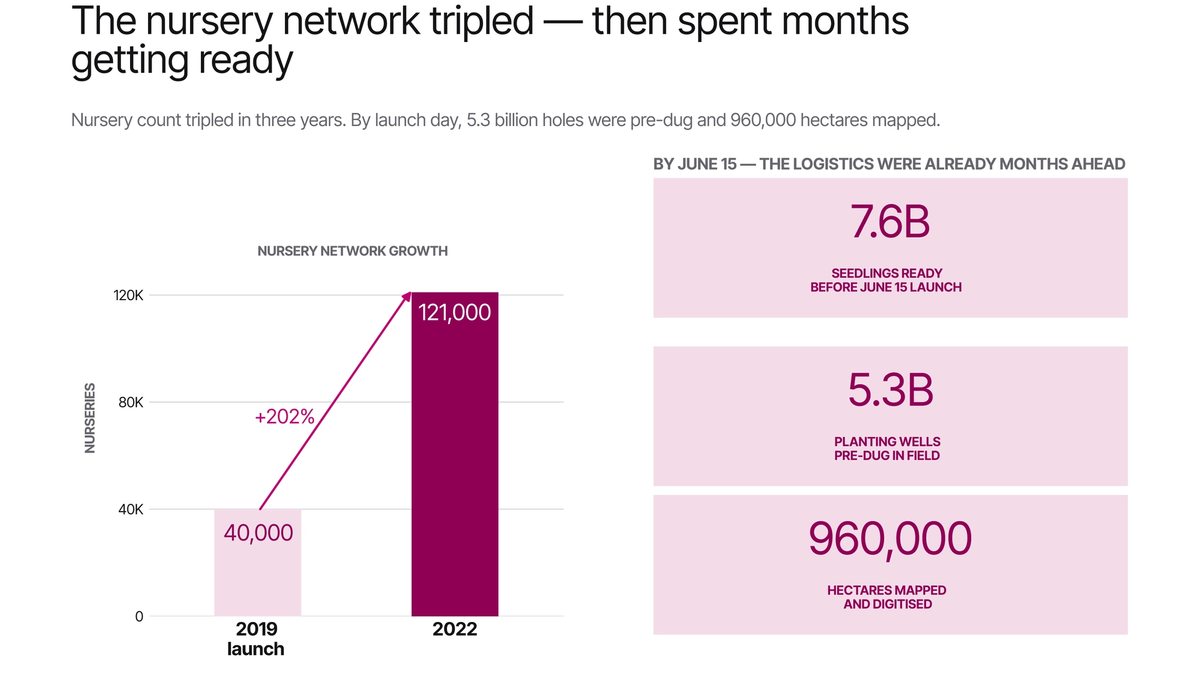
When the Green Legacy Initiative launched in 2019, Ethiopia had roughly 40,000 nurseries. By 2022, that number had grown to 121,000. The nursery network is the infrastructure of the programme. Each nursery — a community cooperative plot, a school garden, a government forestry station, or a private operator contracted by the regional agriculture bureau — begins the season’s seedlings eight to twelve months before the planting day. Seeds are collected from mother trees, treated, germinated in controlled conditions, transplanted to growing bags filled with soil and compost, watered on a cycle, and monitored for disease and root development. A seedling ready for field planting is 15 to 30 centimetres tall with an established root structure. Getting 8 billion seedlings to that point requires seed collection, germination equipment, growing bags, compost, water, and human labour running continuously from approximately October of the previous year.
The 2026 season saw 7.6 billion seedlings ready for planting before the June 15 launch, with 5.3 billion planting wells pre-dug in the field and 960,000 hectares of land mapped and allocated. Pre-digging holes before the planting season starts matters: a 30-centimetre hole filled with compost-enriched soil and left to absorb rainfall for two to four weeks before planting gives the seedling significantly better survival odds than a freshly dug hole on planting day. The Agriculture Ministry coordinates hole preparation with the regional bureaus and woreda-level teams in the months before the event. By the time 21 million Ethiopians arrive at their designated planting sites at dawn, the logistics chain has already been running for months.
THE JOBS: 767,000 DIRECTLY CREATED, CONCENTRATED IN YOUTH AND WOMEN
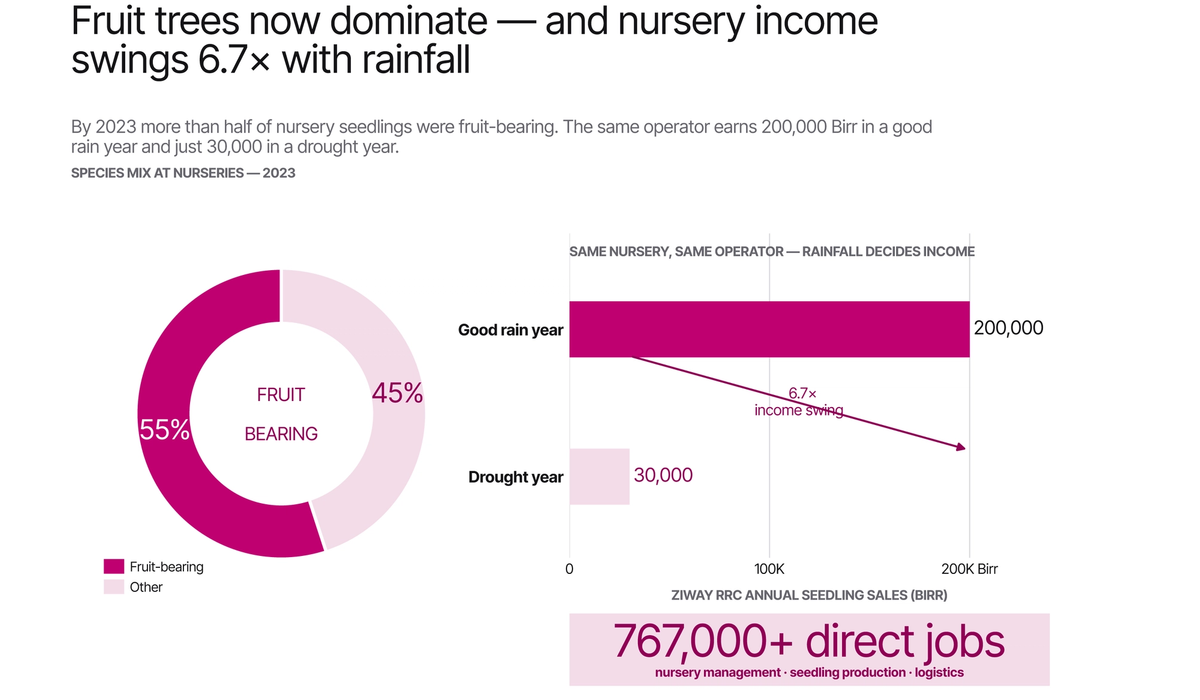
The Green Legacy Initiative has directly created more than 767,000 jobs in nursery management, seedling production, land restoration, and supply chain logistics, concentrated among women and youth. The Rural Resource Centres established by CIFOR-ICRAF and the government represent the commercial tier of the nursery network — business-oriented operations that sell seedlings to the government programme, to NGOs, and to farmers, generating annual income for their operators. In a good rain year, the Ziway RRC in Oromia sold 200,000 Birr of seedlings. In a drought year, that fell to 30,000 Birr — illustrating that the programme’s economic contribution to nursery operators is real but climate-sensitive, the same variable the programme itself is trying to address.
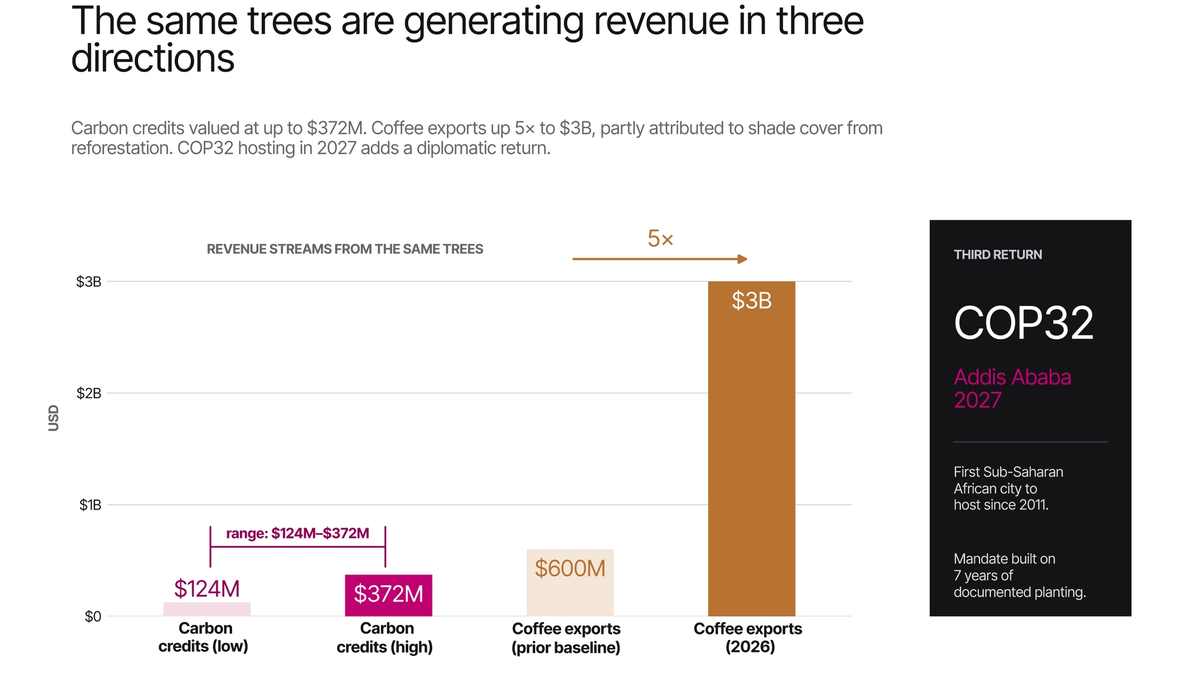
The indirect employment extends further. Compost production, growing bag manufacturing, soil treatment, transport of seedlings from nurseries to planting sites, and post-planting maintenance all generate seasonal labour. In Oromia and SNNP, where the largest nursery concentrations exist, the pre-planting season from October to June is a period of sustained agricultural employment outside the crop calendar. PM Abiy linked the increase in Ethiopia’s coffee export revenue from $600 million to $3 billion annually partly to the shade cover and microclimate benefits produced by reforestation in coffee-growing regions. If that attribution holds across regions, the economic return on the nursery supply chain extends well beyond the jobs directly counted.
THE SPECIES MIX: FROM FAST-GROWING EXOTICS TO FOOD-BEARING INDIGENOUS TREES
In the first years of the programme, the species mix drew criticism from ecologists who raised concerns about the use of fast-growing exotic species — primarily Eucalyptus and Grevillea — which establish quickly but do not support native biodiversity and can reduce water tables. The programme has since shifted substantially toward indigenous and fruit-bearing species. In 2022 alone, more than 500 million seedlings were of premium fruit species — avocado, mango, apple, and papaya — linking reforestation directly to household food security and commercial export potential. By 2023, fruit trees made up 55 percent of the seedlings being prepared at nurseries. The January 2026 training of trainers programme conducted by CIFOR-ICRAF in Addis Ababa specifically addressed seed systems diversity, emphasising that native tree and grass seeds are the foundation of genuine restoration rather than a monoculture cover. The shift from fast-growing exotics to indigenous and food-bearing species is both an ecological improvement and an economic one: a fruiting avocado tree in a household plot generates income. A Eucalyptus generates firewood.
THE TECHNOLOGY: SITUATION ROOMS, SATELLITE MAPPING, AND SURVIVAL TRACKING
The programme operates through a National Green Legacy Technical Committee, with a dedicated Green Legacy Situation Room activated during peak planting periods to coordinate logistics, track progress against daily targets, and receive real-time reporting from regional and woreda-level coordinators. 960,000 hectares of planting land have been mapped and digitised, allowing monitoring from any location with connectivity. A digital monitoring system introduced in recent seasons tracks seedling growth and condition against a target survival rate of 90 percent. Each planting site is registered with GPS coordinates, species planted, date, and the responsible institution or community group. Follow-up verification visits are scheduled at 30, 90, and 180 days post-planting. In December 2024, Ethiopia’s parliament ratified a proclamation establishing the Green Legacy Initiative and Degraded Land Rehabilitation Special Fund, giving the programme a permanent legal and financial foundation and a formal accountability structure independent of any single administration.
THE NUMBERS: WHAT PLANTED MEANS AND WHAT SURVIVED MEANS
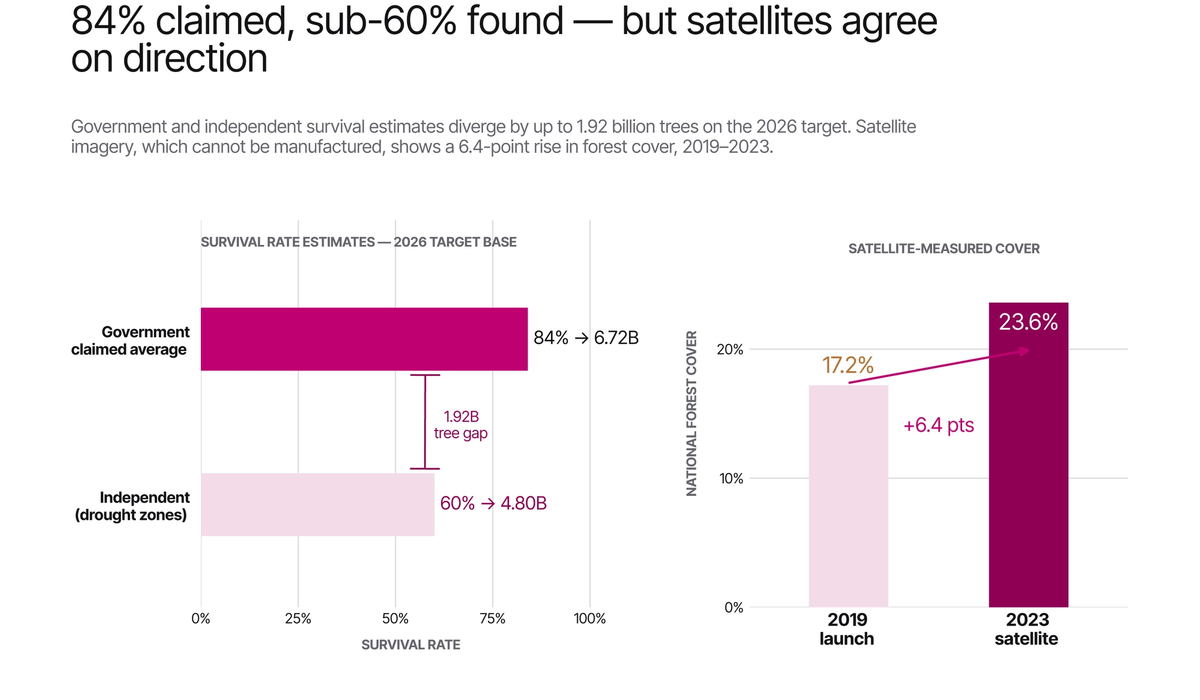
The most searching independent assessment of the programme comes from a Spacedaily analysis published this week, which notes that the 2019 single-day figure of 353 million was not registered with Guinness and was produced by the same government that wanted a large number. Counting a third of a billion seedlings across a thousand sites in twelve hours is an estimate. The same applies at 800 million. The government reports an 84 percent average survival rate. Forest ecologist Tadesse Habtamu of Jimma University and other independent researchers have found survival rates falling below 60 percent in some areas, particularly in drought-affected zones and where post-planting maintenance is insufficient. A 60 percent survival rate on 8 billion seedlings planted this season produces 4.8 billion surviving trees. An 84 percent rate produces 6.72 billion. The difference — 1.92 billion trees — is larger than the total annual planting of most countries with active reforestation programmes. Both are large. The gap between them is also large, and it is what the digital monitoring system and the parliamentary fund are designed to close.
Forest cover has risen from 17.2 percent when the programme launched in 2019 to 23.6 percent by 2023, based on satellite imagery analysis — a 6.4 percentage point increase in four years that represents tens of millions of hectares of additional tree cover. Forest cover cannot be manufactured by counting seedlings. It is measured by satellites. The satellite data and the seedling count are telling the same directional story, even if the precise numbers behind each carry uncertainty. Ethiopia is greener than it was in 2019. By how much exactly is the ongoing scientific debate.
THE RETURN: CARBON CREDITS, FOOD SECURITY, AND THE CLIMATE HOSTING MANDATE
The economic returns from the Green Legacy Initiative are materialising in three directions. First, carbon credits: Ethiopia issued 12.4 million verified emission reductions under the World Bank’s ISFL programme in July 2026 — the first country to do so — with credits valued between $124 million and $372 million depending on market pricing. The Oromia Forested Landscape Programme that generated those credits is the commercial-scale proof that the Green Legacy’s forest cover claims can be independently verified and monetised. Second, food security: 500 million fruit seedlings planted in a single year, a shift toward avocado and mango that links to Ethiopia’s avocado export growth and the household income it generates in Sidama and Oromia. Third, climate diplomacy: Ethiopia has been awarded the right to host COP32, the UN Climate Conference, in Addis Ababa in 2027 — a hosting mandate built on seven years of documented national-scale reforestation that no other African country can match.
On the morning of the single-day event more than 20 million Ethiopians will be in fields, riverbanks, school gardens, roadsides, and degraded hillsides before the birds have finished their first calls. Schools close. Civil servants report to planting sites. Military units deploy to degraded land. The Prime Minister plants. Cabinet plants. It is the one day in the Ethiopian calendar where the government’s environmental ambition and its population’s participation converge into a single, simultaneously occurring act across the whole country. The target is 800 million seedlings in 12 hours. The progression from 353 million in 2019 to 714.7 million in 2025 suggests it is achievable.